
The internet has made everyday life easier, but it has also created new privacy and security concerns. Whenever people browse a website, use an online service, connect to public Wi-Fi, or sign in to an account, information about their digital activity can potentially be collected or exposed.
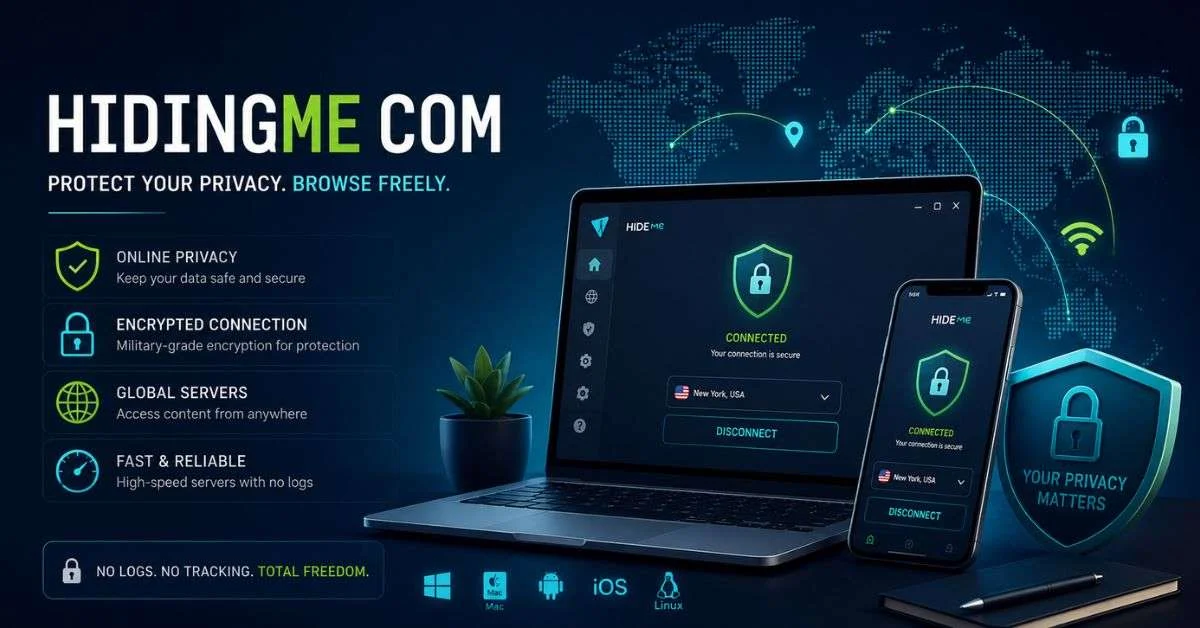
This is one reason interest in hidingme com and similar privacy-focused services continues to grow. Internet users are increasingly looking for practical ways to protect personal information, reduce tracking, secure their connections, and browse the web with greater privacy.
This guide explains the ideas commonly associated with hidingme com, including VPN technology, IP address protection, encryption, anonymous browsing, privacy features, possible limitations, and basic cybersecurity practices. The goal is to provide a simple explanation that helps readers understand what privacy tools can and cannot do.
What Is hidingme com?
The term hidingme com is associated with the broader topic of online privacy, secure browsing, and anonymity-focused internet tools.
Privacy platforms in this category can include technologies and services designed to make internet activity more private. Depending on the provider, these may include:
- Virtual Private Network (VPN) services
- IP address masking
- Encrypted internet connections
- Secure browsing features
- Access to content affected by geographic restrictions
- Anonymous or privacy-focused internet access
The main purpose of these technologies is to give users greater control over their online connection and reduce the amount of information that can be easily observed by third parties.
However, privacy tools should not be viewed as a guarantee of complete anonymity. Their effectiveness depends on the technology being used, the provider’s policies, the user’s settings, and the user’s own browsing behavior.
Why Online Privacy Matters
Online privacy has become an important part of modern internet use. Every visit to a website can contribute to a person’s digital footprint.
Depending on the website, service, browser, or network, information that may be collected can include:
- Browsing activity
- Device information
- Approximate location
- Search behavior
- Cookies
- Tracking data
This information can be used for different purposes, including advertising and user profiling. In some circumstances, exposed information can also increase cybersecurity risks.
For this reason, people interested in hidingme com and related privacy technologies often want to understand how these tools can reduce unnecessary exposure.
Protecting Yourself on Public Wi-Fi
Public Wi-Fi is convenient, but not every public network provides the same level of security.
People commonly connect to wireless networks in:
- Airports
- Hotels
- Cafes
- Restaurants
- Public spaces
If a network is poorly secured, attackers may attempt to intercept sensitive information. A properly configured VPN can encrypt internet traffic, adding another layer of protection when using networks that may not be fully trusted.
Reducing Online Tracking
Advertising and analytics systems can use tracking technologies to understand browsing behavior.
Privacy tools can help limit some forms of tracking by making it harder for third parties to connect online activity directly to a user’s normal IP address or network connection.
This does not mean every tracking method disappears. Websites can still use other technologies, such as cookies and browser fingerprinting.
Accessing Region-Restricted Content
Some websites and online services make content available according to geographic location.
A VPN may allow a user to connect through a server in another region, which can change the apparent location of the connection.
Whether this works depends on the service being accessed, its policies, and the technology used to identify locations.
Protecting Sensitive Data
Encryption is another important part of online security.
When information is encrypted during transmission, it becomes much harder for unauthorized parties to understand the data if they manage to intercept it.
This is particularly useful when users are handling sensitive communications or accessing accounts over networks they do not fully control.
How Privacy-Focused Services Work
Services associated with online privacy generally combine several technologies rather than relying on a single feature.
VPN Encryption
A Virtual Private Network creates an encrypted connection between a device and a VPN server.
Instead of sending traffic directly through the normal internet connection, the device sends it through the VPN connection. This can provide several privacy benefits:
- Internet traffic is encrypted.
- The user’s normal IP address is hidden from websites that see the VPN connection.
- Third parties may have greater difficulty monitoring the traffic.
The exact level of protection depends on the VPN’s technology, configuration, and privacy practices.
IP Address Masking
An IP address is used to identify a device or network connection on the internet and can provide an approximate indication of location.
A VPN can replace the user’s visible IP address with the address of the VPN server.
As a result, websites generally see the VPN server’s IP address instead of the user’s original public IP address.
This is one of the main reasons people researching hidingme com and anonymous browsing are interested in VPN services.
Secure DNS
DNS translates website names into the network addresses required to connect to them.
Some privacy services route DNS requests through protected channels. This can help reduce the ability of an internet service provider or other network observer to see DNS activity.
The precise protection depends on how the service handles DNS requests and whether the user’s device is correctly configured.
No-Logs Policies
A no-logs policy refers to a provider’s stated approach to retaining information about customer activity.
Privacy-conscious users often examine these policies because stored information could potentially expose details about internet usage.
It is therefore useful to look beyond a simple “no logs” claim and examine the provider’s privacy documentation, transparency information, and any available independent audits.
Features to Consider When Choosing a Privacy Service
Not every privacy service provides the same technology or level of protection. Before choosing one, users can compare several important features.
Encryption and Security Protocols
Modern privacy services may support technologies such as:
- AES-256 encryption
- OpenVPN
- WireGuard
- IKEv2
These are widely recognized technologies used in network security and VPN applications.
The specific protocol available can affect factors such as speed, compatibility, and security configuration.
Connection Speed
Encryption and routing internet traffic through an additional server can sometimes reduce connection speed.
The effect varies according to factors such as:
- Server distance
- Server capacity
- Network congestion
- VPN technology
- Internet connection quality
A well-designed service attempts to minimize the performance impact.
Number and Location of Servers
Server locations can influence the browsing experience.
A larger network may give users more choices and can potentially provide:
- More connection options
- Better access to different regions
- Reduced congestion
- Improved speeds in some circumstances
However, the number of servers alone does not determine the overall quality of a privacy service.
Device Compatibility
A useful privacy service should work with the devices people actually use.
Common platforms include:
- Windows
- macOS
- Android
- iOS
- Linux
- Web browsers through extensions
Compatibility is important because privacy protection is less useful if it cannot be applied to the device or platform being used.
Kill Switch
A VPN kill switch is designed to prevent normal internet traffic from continuing if the VPN connection unexpectedly fails.
When enabled, the feature can disconnect the device from the internet until the protected VPN connection is restored.
This can reduce the possibility of accidentally exposing the user’s regular IP address.
Benefits of Using Privacy and Anonymity Tools
Privacy technologies can provide several practical advantages when they are configured and used correctly.
Better Protection on Untrusted Networks
Encrypted VPN connections can provide additional security when using public wireless networks.
This is particularly useful for people who frequently connect to Wi-Fi while traveling or working outside their homes.
Reduced Exposure to Tracking
Privacy tools can make some forms of tracking more difficult by masking the user’s normal IP address and encrypting network traffic.
They are not, however, a replacement for privacy-focused browser settings, tracker blocking, or careful account management.
Greater Access Flexibility
VPN connections can allow users to connect through servers in different geographic locations.
This can be useful when websites or online services provide different access based on region.
Users should still follow the terms of the services they access and applicable laws.
Support for Remote Work
Businesses and remote workers frequently use encrypted network connections to protect company information.
A secure VPN connection can help employees connect to business resources while reducing risks associated with transmitting sensitive data over less trusted networks.
Potential Risks and Limitations
Using a privacy tool does not automatically make someone completely anonymous or secure.
Not Every Provider Can Be Trusted
A service may advertise privacy without necessarily providing the level of protection users expect.
Before choosing a provider, users should examine:
- Privacy policies
- Independent security audits
- Company background
- Ownership information
- Jurisdiction
- Data handling practices
These details can help users understand what happens to their information.
Free Services Can Have Trade-Offs
Free VPNs and other free privacy services may have limitations.
Some may rely on advertising or data collection to generate revenue. Others may provide fewer servers, lower speeds, weaker features, or limited security options.
Therefore, “free” does not automatically mean “private.”
VPNs Can Reduce Speed
Because VPN traffic travels through an additional server and is encrypted, some users may experience slower connections.
The difference can depend on server distance, network congestion, VPN infrastructure, and the user’s original internet speed.
Laws Differ Between Countries
VPN regulations are not identical everywhere.
Some countries regulate or restrict VPN use, while others permit it more freely.
Anyone using a VPN should understand and comply with the laws and regulations that apply to their location.
How to Evaluate a Reliable Privacy Service
Choosing a privacy service should involve more than looking at advertisements or a single feature.
Examine Security Protocols
Look for established protocols such as:
- WireGuard
- OpenVPN
- IKEv2
Users should also consider how the provider explains encryption and security practices.
Check Independent Testing
Independent reviews can provide useful information about:
- Connection speed
- Security
- Privacy policies
- Reliability
- Technical performance
Independent testing can provide additional context beyond a provider’s own marketing material.
Study the Logging Policy
A provider’s logging policy deserves careful attention.
Users should determine what information is collected, why it is collected, how long it is retained, and whether the provider has undergone any independent verification of its privacy claims.
Look for Transparency
A trustworthy privacy service should provide clear information about important areas such as:
- Company ownership
- Data practices
- Security audits
- Privacy policies
- Customer support
Clear documentation makes it easier for users to understand what they are actually getting.
Common Uses for Services Like hidingme com
People use VPN and privacy technologies for different reasons.
Secure Streaming and Browsing
Some users want additional privacy while watching or accessing online content.
A VPN can encrypt the connection and hide the user’s normal IP address from websites that see the VPN server connection.
Remote Work
Companies and employees can use encrypted connections when working remotely.
This can help protect business communications and access to internal resources.
Privacy While Traveling
Travelers often connect to unfamiliar networks.
A VPN can provide an encrypted connection when accessing services such as banking, email, or communications while away from home.
Managing ISP Throttling Concerns
In some situations, internet providers may slow particular types of traffic.
Because VPN traffic is encrypted, the provider may have less visibility into the specific type of content being transferred. However, VPNs do not guarantee that throttling will disappear, and they can sometimes reduce speeds themselves.
VPN vs Proxy: Understanding the Difference
VPNs and proxy servers are sometimes treated as if they are identical, but they are different technologies.
| Feature | VPN | Proxy |
|---|---|---|
| Encryption | Yes | Usually No |
| Security Level | High | Moderate |
| Typical Speed | May be slightly slower | Often faster |
| Device Protection | Can cover the entire device | Often limited to a specific application or browser |
| Privacy Protection | Stronger | More limited |
A proxy can route traffic through another server and hide an IP address in certain situations. A VPN generally provides broader protection because it can encrypt the device’s network connection.
For users researching hidingme com, understanding this difference is important because changing an IP address is not the same thing as encrypting internet traffic.
Does a VPN Provide Complete Anonymity?
No technology can guarantee 100% anonymity online.
A VPN can improve privacy, but other methods can still connect online activity with an individual.
For example, privacy can be affected when someone:
- Logs into a personal account
- Uses a browser with a distinctive fingerprint
- Installs malware
- Downloads unsafe files
- Shares identifying information online
A VPN should therefore be considered one component of a broader privacy strategy rather than a complete anonymity solution.
Cybersecurity Practices Beyond VPN Protection
Using a VPN is only one step toward safer internet use.
Create Strong and Unique Passwords
Accounts should use passwords that are difficult to guess.
A strong password can include:
- Uppercase letters
- Lowercase letters
- Numbers
- Symbols
Using different passwords for different accounts is also important. A password manager can make this easier.
Turn On Two-Factor Authentication
Two-factor authentication, commonly called 2FA, adds another verification step when signing into an account.
Even if someone obtains a password, the additional authentication requirement can provide another layer of account protection.
Keep Devices Updated
Operating system and software updates frequently include security fixes.
Keeping applications and devices updated can reduce exposure to vulnerabilities that attackers may attempt to exploit.
Be Careful With Links
Phishing remains a major online security problem.
Users should be cautious when receiving unexpected links, attachments, login requests, or messages asking for sensitive information.
How Businesses Use Privacy Technology
Privacy tools are also important in business environments.
Secure Employee Connections
Organizations can use encrypted connections to allow employees to access internal systems remotely.
This can be especially useful when employees work from different locations.
Reduce Data-Breach Risks
Cyberattacks can expose customer records, business communications, and other sensitive information.
Security technologies, including encrypted network connections, can form part of a company’s wider strategy for reducing these risks.
Protect Confidential Information
Businesses often handle intellectual property, financial information, customer data, and private communications.
Encrypted connections can help protect such information while it moves between devices and systems.
The Growing Importance of Digital Privacy
Digital privacy is becoming a larger part of the conversation around technology.
Governments, businesses, cybersecurity professionals, and ordinary internet users are paying increasing attention to how personal information is collected, stored, shared, and protected.
Several developments are contributing to this growing interest:
- Stronger data protection regulations
- Greater use of VPN technology
- Increased cybersecurity awareness
- Growing demand for encrypted communications
- More concern about online tracking
As people become more aware of their digital footprint, interest in privacy-related searches such as hidingme com is likely to remain connected with the wider discussion about safer internet use.
What Could the Future of Online Privacy Look Like?
Privacy technology continues to develop as internet threats become more sophisticated.
Future privacy solutions may involve technologies such as:
- Faster encryption
- AI-assisted threat detection
- Decentralized privacy networks
- More advanced anti-tracking systems
The exact direction of the industry will depend on technological development, regulation, consumer demand, and the changing nature of cyber threats.
For users, the main lesson is simple: online privacy will continue to be an important part of digital security.
Practical Privacy Checklist
People who want to improve their online privacy can begin with a few basic steps:
- Use strong and unique passwords.
- Enable two-factor authentication.
- Keep operating systems and applications updated.
- Avoid suspicious websites and links.
- Be careful when using public Wi-Fi.
- Review browser privacy settings.
- Research VPN providers before using them.
- Read the provider’s privacy and logging policies.
- Understand local VPN regulations.
- Remember that no single tool guarantees complete anonymity.
Combining these practices with an appropriate privacy service can provide a more complete approach to online security.
FAQs About hidingme com
What is hidingme com associated with?
hidingme com is associated with the broader subject of online privacy, anonymous browsing, VPN technology, IP address masking, and internet security tools.
Can a VPN completely hide my identity?
No. A VPN can improve privacy by encrypting network traffic and hiding the user’s normal IP address, but it cannot guarantee complete anonymity. Account logins, browser fingerprinting, malware, downloads, and other factors can still reveal information about a user.
Are free privacy services safe?
Not necessarily. Some free services may be useful, but others can have limitations involving advertising, data collection, security features, or performance. Users should research a provider before trusting it with internet traffic.
Why do people use VPN services?
Common reasons include improving privacy, securing connections on public Wi-Fi, accessing geographically restricted content, protecting remote-work connections, and reducing some forms of online tracking.
Is using a VPN legal?
VPN laws differ by country. VPN use is permitted in many places, while some jurisdictions impose restrictions or regulations. Users should check and follow the laws applicable to their location.
Is a proxy the same as a VPN?
No. Both can route traffic through another server, but a VPN generally provides broader protection and encryption, while many proxies do not encrypt traffic and may only affect a particular application or browser.
Does a VPN stop all online tracking?
No. A VPN can hide the user’s normal IP address and encrypt network traffic, but it does not eliminate every tracking method. Cookies, browser fingerprinting, account activity, and other technologies can still be used to identify or track users.
Is a VPN enough to stay safe online?
A VPN is only one part of cybersecurity. Strong passwords, two-factor authentication, software updates, safe browsing habits, and caution around suspicious links are also important.
Conclusion
The growing interest in hidingme com reflects a much wider concern about privacy, cybersecurity, tracking, and safe internet access.
VPNs and other privacy technologies can provide useful protection by encrypting connections, masking IP addresses, improving security on public Wi-Fi, and reducing certain forms of online monitoring. They can also support remote workers, travelers, and businesses that need safer network connections.
At the same time, users should understand the limitations. A VPN does not provide guaranteed anonymity, every provider does not offer the same level of protection, and free services may involve important trade-offs.
The safest approach is to combine a carefully researched privacy service with good cybersecurity habits. Strong passwords, two-factor authentication, updated software, cautious browsing, and awareness of privacy policies all play an important role.
Ultimately, understanding how privacy technologies work is just as important as using them. With better knowledge and responsible online habits, users can make more informed decisions about protecting their digital information.



Leave a Reply
You must be logged in to post a comment.